







Masseter Muscle: Anatomy, Function, Pain Relief, and Treatment Options
Put two fingers on your cheek, just in front of your ears, and clench your jaw. That bulge you feel is the masseter muscle doing its job. It’s one of the hardest-working muscles in your body, and most people never think about it until it starts to ache, feels tight after a stressful week, or looks a little more prominent than they’d like in photos.
This guide breaks down the masseter muscle in plain language: where it sits, what it actually does, why it causes so much jaw and headache trouble, and what genuinely helps when it’s overworked. We’ll also cover masseter hypertrophy, the condition behind that squarer jawline some people notice, and walk through realistic treatment options, including where Botox fits in and where it doesn’t.
What Is the Masseter Muscle?
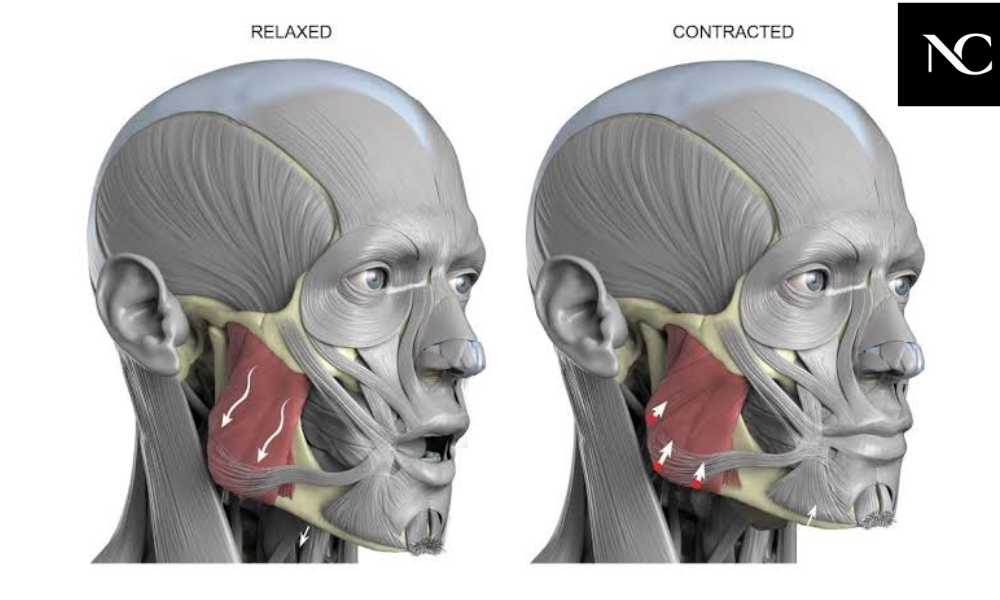
The masseter muscle is a thick, rectangular muscle located on each side of the jaw, running from the cheekbone (zygomatic arch) down to the lower jawbone (mandible). It’s the primary muscle responsible for closing your mouth and generating the force needed to chew. Along with the temporalis and the two pterygoid muscles, it belongs to a group known as the muscles of mastication, and it’s widely cited as the strongest muscle in the human body relative to its size.
Where the Masseter Muscle Is Located
The masseter sits just under your cheek, covering the back portion of your lower jaw, roughly between your ear and the corner of your mouth. You can feel it easily: clench your teeth and press your fingertips against your cheek, right above your jawline. The muscle bulges outward as it contracts, which is exactly why dentists and physical therapists use this same clenching test to check for tension or overuse.
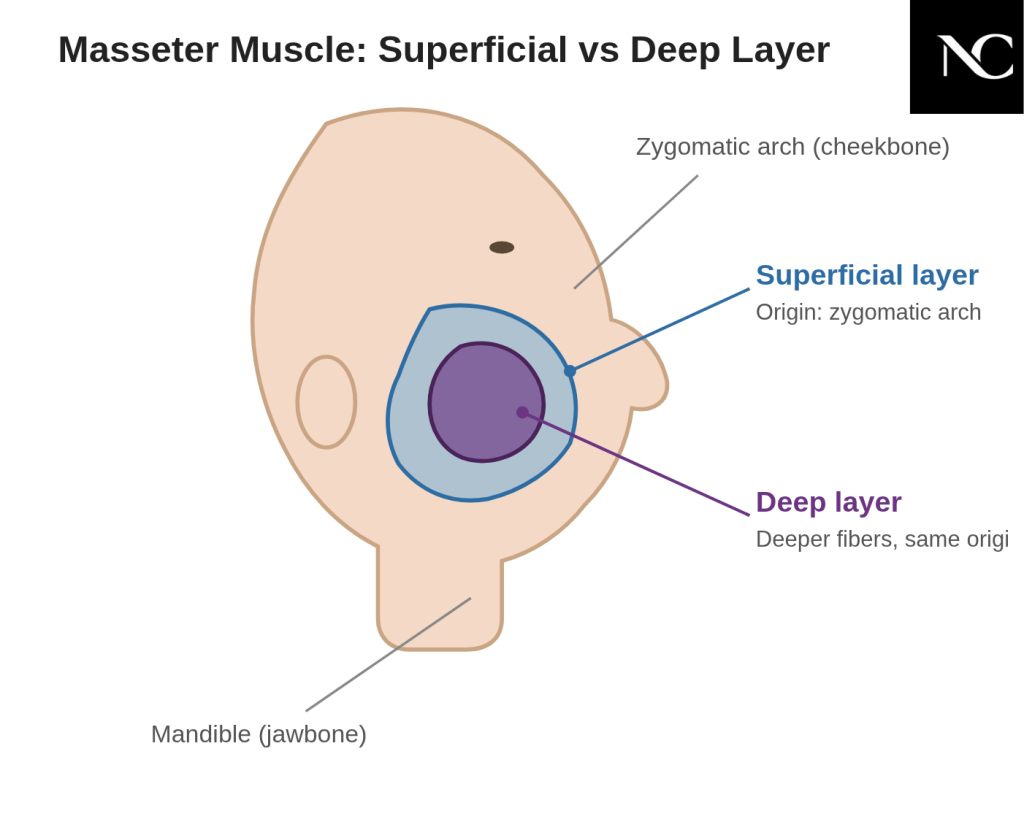
Structurally, the masseter has two main layers that work together:
- Superficial layer – the larger, more visible portion, running from the zygomatic bone (cheekbone) down to the angle of the jaw.
- Deep layer – a smaller, more vertical section that sits underneath, attaching further up along the jaw near the coronoid process.
Some anatomy references also describe a third, less consistent “coronoid” portion, though the two-layer model is what you’ll find in most standard textbooks.
What Does the Masseter Muscle Do?
Its main job is elevation of the mandible, meaning it closes your jaw and generates biting force. It also assists with a small amount of forward jaw movement (protrusion) and helps stabilize the temporomandibular joint (TMJ) when you clench or bite down hard.
Here’s the full anatomical snapshot in one place:
| Attribute | Detail |
| Origin | Zygomatic arch and zygomatic process of the maxilla |
| Insertion | Angle and lateral surface of the ramus of the mandible |
| Action | Elevates the mandible (closes the jaw); assists in protrusion |
| Innervation | Masseteric nerve, a branch of the mandibular division (V3) of the trigeminal nerve |
| Blood supply | Masseteric artery, a branch of the maxillary artery |
If you’ve ever wondered why a dentist checks your jaw muscles when you complain of headaches, it’s because the masseter, the TMJ, and the trigeminal nerve are all closely linked. Trouble in one area tends to show up in the others.
Masseter vs. Temporalis: What’s the Difference?
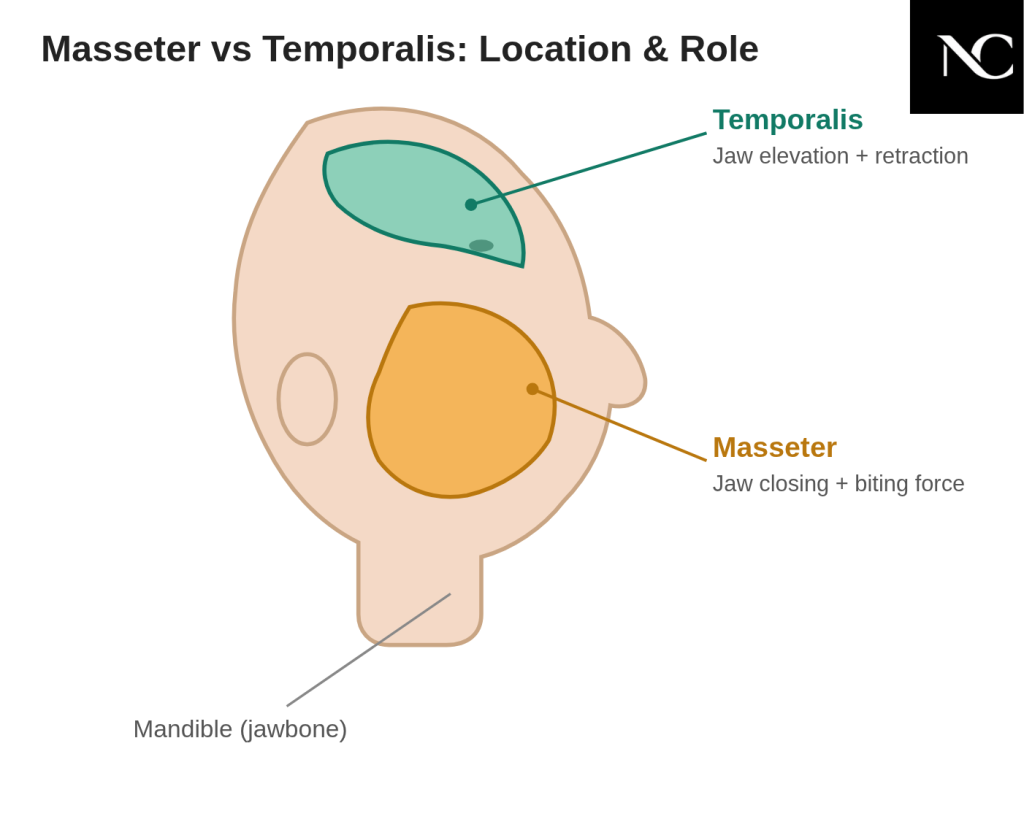
People often confuse the masseter with the temporalis muscle, since both close the jaw. Here’s a simple side-by-side comparison:
| Feature | Masseter | Temporalis |
| Location | Cheek, over the jaw angle | Side of the skull, above and in front of the ear |
| Main action | Powerful jaw elevation | Jaw elevation and retraction (pulling jaw back) |
| Felt when | Clenching teeth | Clenching or grinding, especially side-to-side |
| Common issue | Hypertrophy, jaw clenching soreness | Tension headaches, temple tightness |
In practice, the two muscles almost always work together, so most people experience tightness or soreness in both areas at once rather than isolated to just one.
Why Does the Masseter Muscle Hurt?
Masseter pain is one of the most common reasons people end up searching for this muscle in the first place. In most cases, the pain isn’t from an injury but from repetitive overload: clenching, grinding (bruxism), chewing gum for long stretches, or unconsciously tensing the jaw during stress.
Common causes include:
- Nighttime teeth grinding (bruxism)
- Daytime jaw clenching, often tied to stress or concentration
- Temporomandibular joint (TMJ) dysfunction
- Poor posture, especially a forward head position that changes jaw mechanics
- Trigger points (small, sensitive knots within the muscle fibers)
- Overuse from excessive gum chewing or eating very hard/chewy foods
What makes masseter pain tricky is that it doesn’t always stay put. It’s known for referred pain, meaning discomfort that starts in the jaw can show up as an earache, a tension headache, tooth sensitivity, or even a ringing sensation in the ear. If you’ve been told your headaches are “probably just stress” but never connected them to jaw tension, it’s worth paying attention to whether your jaw feels tight, especially first thing in the morning.
How to Relax a Tight Masseter Muscle
If your masseter feels sore or tense, a few simple, low-risk techniques tend to help most people within a couple of weeks of consistent practice.
- Self-massage. Using two or three fingers, apply gentle circular pressure along the muscle, from just below the cheekbone down to the jaw angle. Thirty to sixty seconds per side, once or twice a day, is a reasonable starting point.
- Warm compress. Applying heat for ten to fifteen minutes before massage increases blood flow and makes the tissue easier to work with.
- Jaw awareness breaks. Throughout the day, check in with your jaw. If your teeth are touching when you’re not eating, that’s usually a sign of clenching. Let your jaw hang loosely with lips closed and teeth apart.
- Soft-food days. When the muscle is especially sore, giving it a short break from tough, chewy foods reduces the mechanical load.
- Stress management. Since clenching is often a stress response, techniques like slow breathing or short mindfulness breaks can reduce how often the muscle tenses up in the first place.
None of these replace a professional evaluation if pain is severe, one-sided, or paired with a jaw that locks or won’t open fully. Those are signs worth having checked by a dentist or TMJ specialist rather than managing at home.
Masseter Hypertrophy: When the Muscle Gets Bigger
Masseter hypertrophy refers to an enlarged masseter muscle, sometimes on one side of the face and sometimes both. It’s often linked to habitual clenching or grinding, though in a fair number of cases the exact cause isn’t clear. It’s generally harmless from a health standpoint, but for some people it changes the shape of the jawline in a way they’d rather not have, giving the face a more square or angular look.
This is where the conversation shifts from “purely medical” to partly aesthetic, and it’s also where the treatment landscape gets more interesting.
Treatment Options Compared
| Treatment | What It Does | Downtime | Duration of Effect | Considerations |
| Botulinum toxin (Botox) injections | Temporarily weakens the muscle, reducing size and clenching force | Minimal, back to normal activity same day | Roughly 3-6 months, then repeat | Widely used and generally well tolerated; requires ongoing sessions |
| Occlusal splint / night guard | Reduces mechanical load from grinding, protects teeth | None | Ongoing while worn | Doesn’t shrink the muscle, but limits further strain |
| Physical therapy / manual release | Reduces trigger points and tension through hands-on techniques | None | Varies, often needs repeat sessions | Good for pain relief, less effective for pure size reduction |
| Surgical reduction | Physically removes or reshapes muscle tissue | Weeks of recovery | Long-lasting or permanent | More invasive, reserved for select cases; used far less often than Botox |
If your main concern is pain and function, physical therapy and a night guard are usually the first line of defense. If the concern is more about jawline appearance, Botox has become the more commonly chosen option because it’s less invasive than surgery, though it does require maintenance injections to keep the effect going.
Living With Masseter Issues: A Realistic Take
It’s worth being honest here: most masseter tension resolves with consistent, boring habits rather than a single fix. Massaging your jaw once and expecting it to feel perfect the next day isn’t realistic, in the same way that stretching your hamstrings once doesn’t undo months of tightness. What tends to work is small, repeated effort: noticing when you’re clenching, giving the muscle a break from tough foods during flare-ups, and being patient with massage and stretching over several weeks.
On the other hand, if pain is sharp, one-sided, or comes with a jaw that clicks, locks, or won’t open properly, that’s not something to just massage through. That pattern points toward a TMJ problem that benefits from a proper assessment rather than guesswork.
Read More: https://newscourt.co.uk/ruth-jones/
FAQs
Where is the masseter muscle located?
It’s located on each side of the face, running from the cheekbone down to the jawbone. You can feel it bulge just below your cheek when you clench your teeth.
What does the masseter muscle do?
It’s the main muscle responsible for closing the jaw and generating the force used in chewing and biting.
What nerve controls the masseter muscle?
The masseteric nerve, a branch of the mandibular division (V3) of the trigeminal nerve, controls the masseter.
Is the masseter the strongest muscle in the human body?
By weight, it’s often described as the strongest muscle in the body because of the amount of force it can generate relative to its size, particularly during biting.
What causes masseter muscle pain?
Common causes include teeth grinding, daytime jaw clenching, TMJ dysfunction, poor posture, and overuse from excessive chewing.
How do you relax a tight masseter muscle?
Gentle self-massage, warm compresses, conscious jaw relaxation throughout the day, and reducing hard or chewy foods during flare-ups all help.
What is masseter hypertrophy?
It’s an enlargement of the masseter muscle, often linked to clenching or grinding, that can change the shape of the jawline.
Can Botox shrink the masseter muscle?
Yes, Botox injections temporarily weaken the muscle, which reduces its size and clenching force, typically lasting three to six months before needing another treatment.
Final Thoughts
The masseter muscle does a lot of quiet, unglamorous work every time you eat, talk, or even just breathe with your mouth closed. Most of the time it goes unnoticed, but between clenching habits, stress, and the occasional bout of TMJ trouble, it’s a muscle that deserves more attention than it usually gets.
If your jaw has been feeling tight, sore, or more prominent than usual, start with the basics: gentle massage, awareness of clenching, and a break from tough foods. If things don’t improve after a few weeks, or if you notice locking, clicking, or one-sided pain, it’s time to get a professional opinion rather than keep guessing. A dentist or TMJ specialist can tell you whether you’re dealing with simple muscle tension or something that needs a more targeted plan.